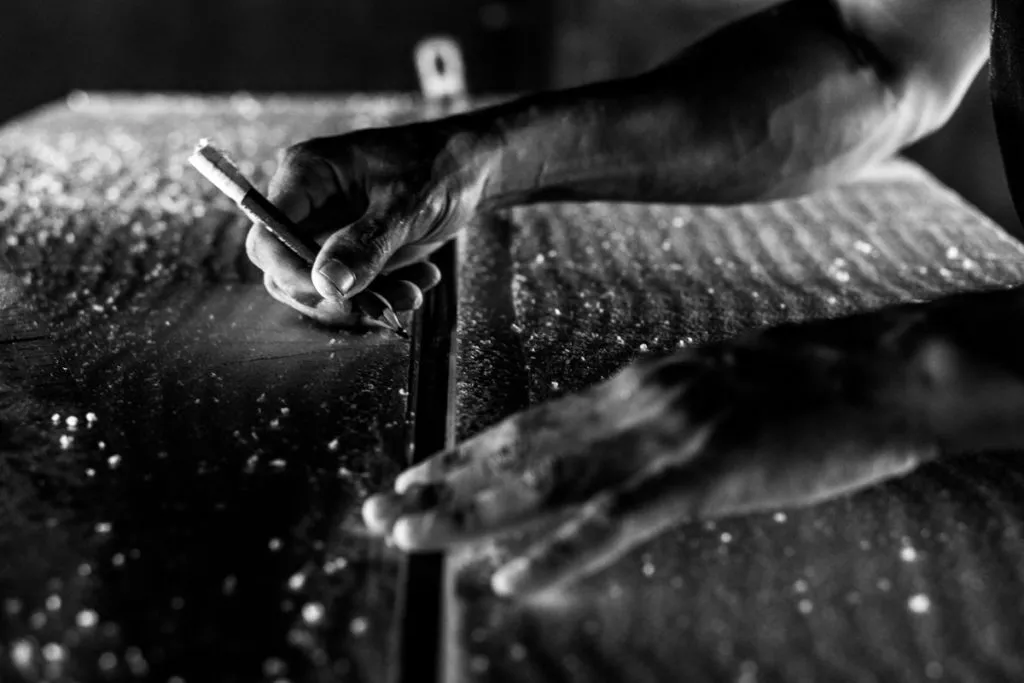
The dust is the first thing you notice. A fine pale snow of polyurethane that settles on everything in the room — on Marty Coelho’s forearms, on the radio, on the half-finished blank balanced between two stands like a body on a table. He does not appear to notice it at all.
There is a smell that belongs to a shaping bay and to nowhere else. Resin, foam, the faint acid of catalyst, the dry chalk of finished sanding. Marty has smelled it almost every day since 1974, when he was nineteen years old and bought his first planer with the money from a summer of pulling tables at a Daytona seafood joint. He still has the planer. He still has the seafood place’s apron, somewhere. The boards he shapes today are not very different from the boards he was shaping then, which is exactly the point he would like you to understand.
“Everybody thinks the technology changed everything,” he says, not looking up from the rail he is fairing with a piece of screen, his hand moving in the long unhurried strokes of a man who has done this several thousand times. “The technology changed the margins. It didn’t change the work. The work is still hands on foam.”
A Coast That Built Its Own
Florida’s East Coast was, for a long time, a stepchild in the official story of American surfing. The magazines came from California. The films came from California. The waves came from California. To grow up surfing on the Volusia coast in the late 1960s and the 1970s was to live downstream of a culture that wasn’t really speaking to you, on waves that broke differently than the ones in the photographs, on a coast that needed boards designed for what was actually out there — softer beach break, shorter rides, the strange and beautiful Atlantic that does not behave like the Pacific and never will.
So the shapers showed up. They had to. Buying a board from California and shipping it east was an act of faith and freight cost, and the boards that arrived were often the wrong tool for the job. The local answer was to learn to shape, in a garage, from a book or from a friend or from no one at all, and to build something that worked for the water you had instead of the water you wished you had.
By the mid-seventies a loose network of garage shapers stretched from Cocoa Beach up through Daytona, Ponce Inlet, and into New Smyrna — most of them young, most of them broke, most of them shaping a handful of boards a month for local kids whose names they already knew. There was no industry. There was a scene.
What Foam Remembers
Marty did not invent anything. He would be the first to tell you that. He learned from a man named Lou Petralia in a back bay off Beach Street in 1975, and Lou had learned from a man named Charlie whose last name is now lost, and Charlie had learned from someone in California whose name was never told to him in the first place. The lineage runs upstream until it disappears into rumor. That is the way it is supposed to work.
What Marty did do, with his own hands and over fifty-some years, was shape an estimated nine thousand boards for people who lived within thirty miles of where he is standing right now. Some of those boards are still in rotation. Some are hanging on walls in living rooms. A few are at the bottom of the Atlantic, having served their purpose. He keeps a list of every name in a series of spiral notebooks. He can find any board he ever shaped if you give him a year and a first name.
“You make a board for a kid at fourteen, you watch him paddle out on it for twenty years, and then his son shows up in the bay and you start over. That’s the whole job.”
The Next Hands
The trade is not dying, exactly, but it is thinner than it was. The big factories produce boards faster and cheaper than any garage ever could, and a new surfer at a chain shop will mostly buy what is in the rack. Marty does not seem worried. He has an apprentice now — Lila Restrepo, twenty-six, who showed up at his door a year ago having taught herself the basics from YouTube and old books, asking if she could sweep in exchange for being allowed to watch.
She has shaped seven boards under his eye so far. The first three were, in his characterization, “corrected.” The most recent he describes as “hers.” She is the seventh person he has trained in the trade, and she is the first woman, and he mentions both facts in the same flat tone, which is to say he does not appear to find either of them remarkable. The work is the work.
“I told her the same thing somebody told me,” he says. “You don’t shape boards for money. You shape boards because you want there to still be boards being shaped. The day nobody’s doing this anymore on this coast is the day the coast loses something it can’t get back.”
He finishes the rail he is fairing. He runs a hand down it, end to end, with his eyes closed. He nods once, to himself, and reaches for the next pass. Outside, the afternoon swell is starting to fill in. Some kid will be riding what he is making here, in a month, on a wave that nobody in California ever heard of, on a coast that has been building its own boards for sixty years and is in no particular hurry to stop.